The founder communication operating system
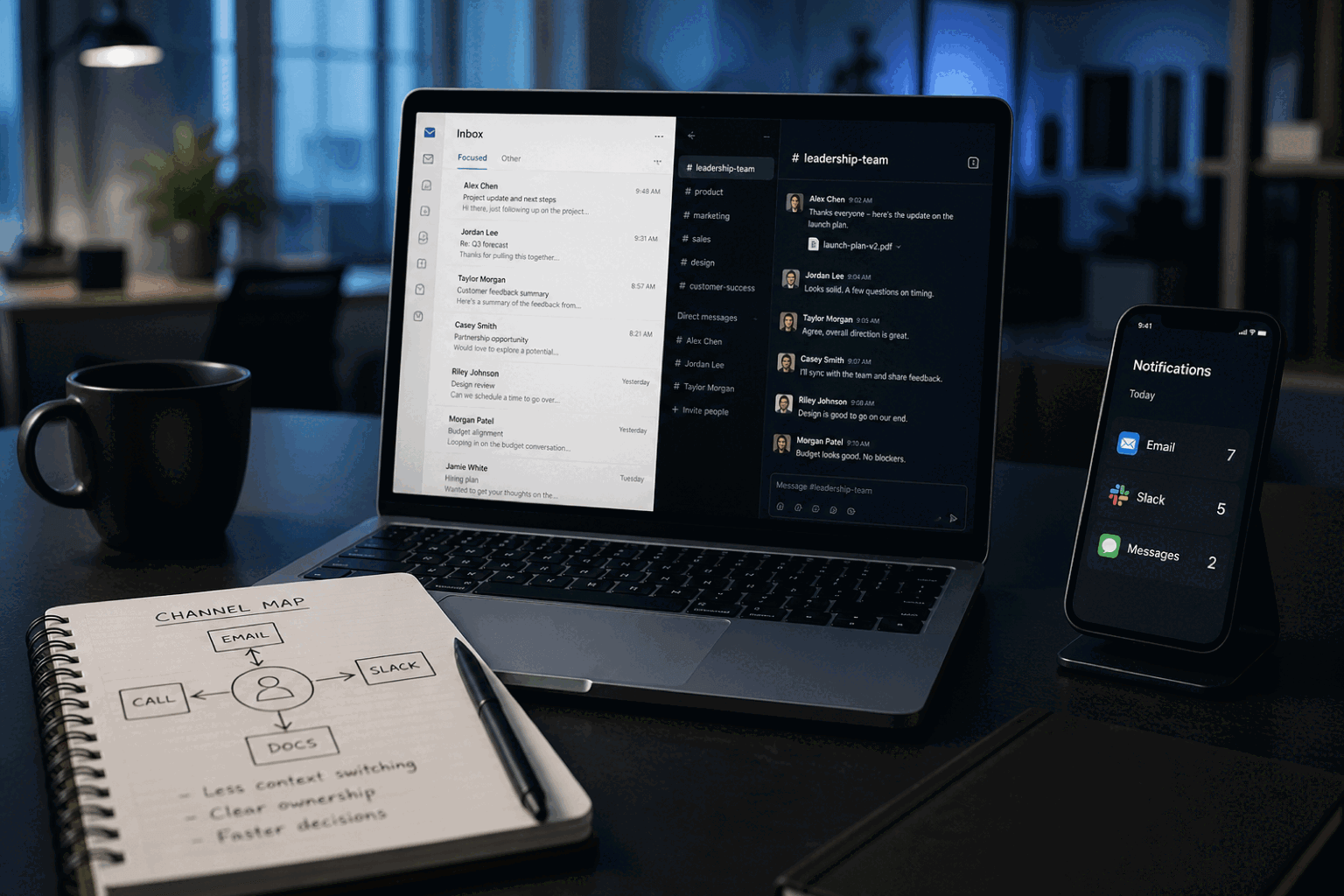 Most founders think they have an email problem. They actually have a communication-routing problem spread across a dozen channels — email, Slack, Teams, DMs, texts, calls, meetings, docs, and comment threads — that all compete for the same finite attention.
The scale is easy to underestimate. Grammarly's 2024 State of Business Communication found knowledge workers now spend 88% of the workweek communicating across all channels combined. Microsoft's 2025 data shows the average worker taking in 117 emails and 153 Teams messages a day and getting interrupted roughly every two minutes during core hours. Adding a faster email client to that does nothing if the real problem is that everything arrives everywhere. You need an operating system for communication, not just for the inbox.
The core principle: every channel needs a job and an SLA
Communication breaks down when the same message can reach you five ways and any channel can mean "urgent." The fix is to assign each channel one job and one response-time contract, then hold the line. When people know where to reach you for what — and when to expect an answer — they stop broadcasting the same ask across every surface to get your attention.
The channel map
Give every channel a single, stated purpose:
Real-time internal → Slack / Teams. Fast, ephemeral, team-facing coordination. Not a system of record. If it needs to be found in six months, it does not live here.
Asynchronous + external + official record → email. Investors, customers, partners, contracts, anything you may need to cite later. This is the durable layer. (For the deep version of this layer, see the founder email operating system.)
High-bandwidth, ambiguous, or emotional → meetings / calls. Reserved for decisions, conflict, relationship-building, and anything that would take twenty messages to resolve. Everything else is a meeting that should have been a message.
Broadcast & decisions → written updates / docs. Weekly internal updates, investor updates, and a decision log. One-to-many, durable, searchable — the antidote to explaining the same thing ten times.
Genuinely urgent → text / phone. Reserved for true escalations. If everything is a text, nothing is urgent.
The email vs Slack vs Teams breakdown goes deeper on drawing these lines.
Response-time contracts
Publish expectations so nobody escalates out of anxiety. A workable default:
Text/phone: minutes — true emergencies only.
Slack/Teams: within a few hours during work hours; no expectation after.
Email: same or next business day. (The cross-industry average reply is ~4 hours in work hours per EmailAnalytics — matching expectations is enough; you don't need to be instant.)
Docs/async updates: read by a stated day, not on arrival.
The point of an SLA is not speed — it is permission to not respond instantly on the channels where instant response was never required.
The routing rules
Three rules keep the system from collapsing:
One message, one channel. No sending the same ask by email and Slack and text. Pick the channel that matches the job. Double-posting trains everyone to escalate everywhere.
Escalate up, never sideways. If a channel's SLA passes and it's truly urgent, move up the ladder (email → Slack → text), not to a second channel at the same level.
Convert, don't duplicate. A decision made in Slack gets written into the doc or email of record. A meeting produces notes in the durable layer. Ephemeral channels feed the permanent one — they don't replace it.
Meetings are communication too
Meetings are the most expensive channel, so treat them as a deliberate choice. Default to async: a written proposal with comments resolves most things without a calendar hold. Reserve live time for decisions, ambiguity, and relationships. Every meeting that does happen produces a short written output — decision, owners, next step — that lands in the durable layer. A meeting with no written trace didn't happen as far as the rest of the company is concerned.
The written backbone
The highest-leverage move in the whole system is shifting weight from reactive channels to a few durable, one-to-many artifacts:
The weekly internal update. What shipped, what's next, what's blocked — written once, read by everyone, killing dozens of status pings.
The monthly investor update. Sent on a fixed cadence so investors stop DMing for ad-hoc check-ins.
The decision log. A running record of what was decided and why. It ends the "wait, what did we agree?" thread forever.
This backbone pairs naturally with a real operating cadence — the meeting and OKR rhythm that scales a team past Series A.
Where the inbox sits in all this
Even with perfect routing, email remains the founder's highest-stakes channel — the durable, external, on-the-record layer where investors, customers, and candidates live. It also attracts the most noise, which is why founders drown in email specifically as they scale.
A communication OS only works if that layer stays legible. Faraday handles the durable channel: it classifies and prioritises across Gmail and Outlook, surfaces what needs a reply, and tracks follow-ups — so the record layer of your OS doesn't quietly become the pile everything falls into.
Install it in one week
Day 1: Write the channel map — one job per channel — and share it with the team.
Day 2: Publish response-time contracts per channel. Turn off notifications that violate them.
Day 3: Set the "one message, one channel" and escalation rules. Model it yourself.
Day 4: Move standing status meetings to written weekly updates.
Day 5: Start the decision log and the investor-update cadence.
Day 6: Tighten the inbox — VIP senders surfaced, noise batched.
Day 7: Review what still interrupted you across every channel, and adjust the map.
By the following week the difference is felt as fewer places to check, clearer expectations, and communication that supports the work instead of becoming it.
Communication OS FAQ
What is a communication operating system for founders?
It's a deliberate system that assigns each channel — email, Slack/Teams, meetings, docs, text — one job and one response-time expectation, plus rules for routing and escalation. It replaces ad-hoc, everywhere-at-once communication with a predictable structure.
How is it different from an email management system?
An email system organises one channel. A communication OS sits above all channels and decides which medium each message belongs in — so email only carries what email is for. The email system is a component of the larger OS.
Which channel should I use for what?
Slack/Teams for real-time internal coordination, email for asynchronous external and official-record mail, meetings for high-bandwidth or ambiguous decisions, written updates and docs for broadcast and decisions, and text/phone for genuine emergencies only.
How do I stop the same message coming through five channels?
Publish a "one message, one channel" rule and an escalation ladder, and model it yourself. When people trust the SLA on each channel, they stop broadcasting the same ask everywhere to get attention.
What's the highest-leverage part of a communication OS?
The written backbone — a weekly internal update, a monthly investor update, and a decision log. Shifting weight from reactive channels to durable one-to-many artifacts eliminates the most repetitive communication load.