The state of the founder inbox 2026
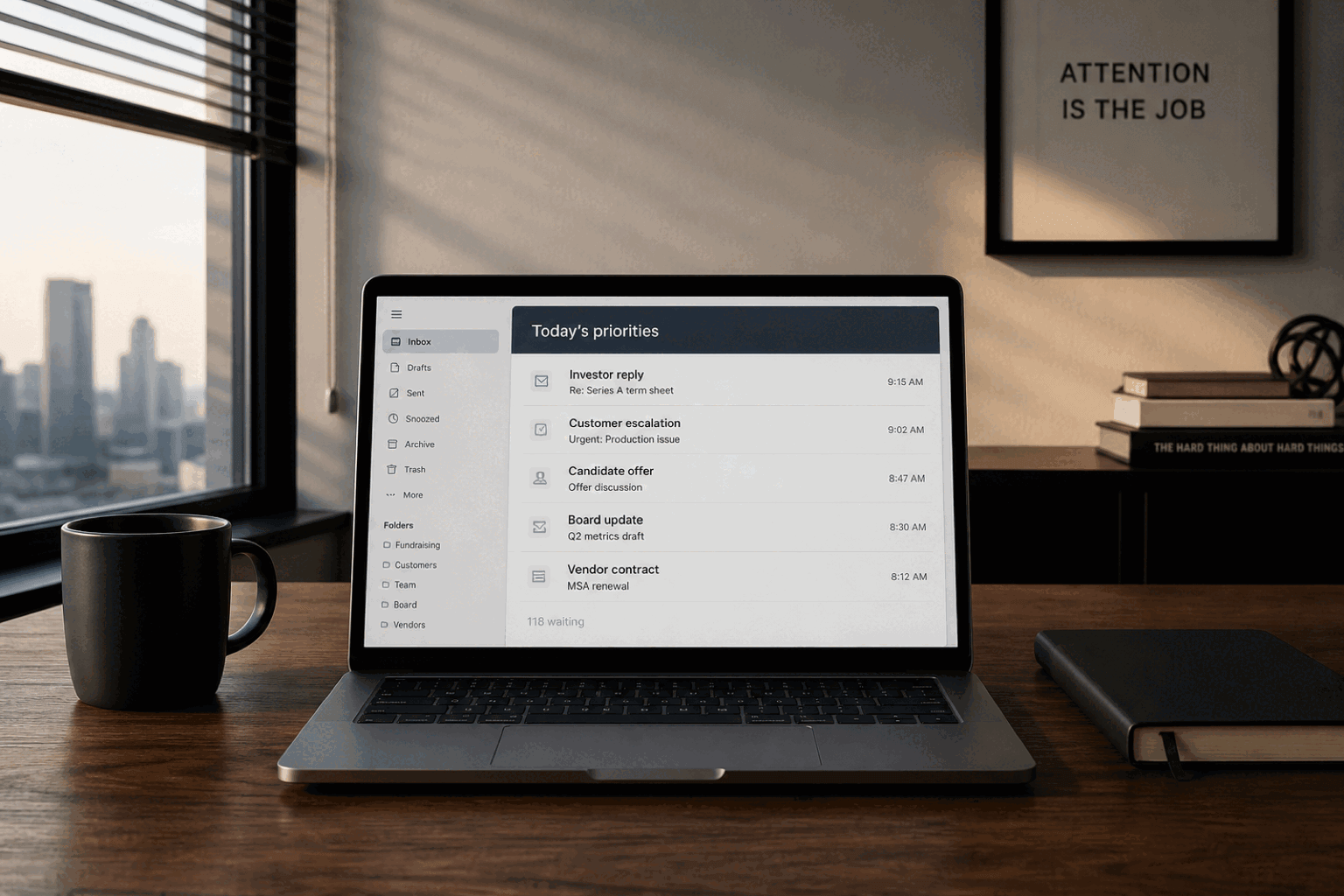 The promise of 2026 was simple: AI would finally fix email. Smart replies, autonomous agents, an inbox that triages itself. And yet the founder's inbox is winning the war for attention more decisively than ever.
This is the paradox of email in 2026 — better tools, same problem. Below is what the public data actually shows about how founders and operators spend their attention on email, drawn from Microsoft, McKinsey, Harvard Business School, the Radicati Group, and others. No vanity numbers. Just the picture, sourced.
The volume is still climbing
The average knowledge worker receives 117 emails a day, per Microsoft's 2025 Work Trend Index (built on Microsoft 365 telemetry across trillions of signals). cloudHQ's 2025 workplace stats put it at 121 received and ~40 sent. For executives it is worse: C-suite leaders commonly field 150–200+ emails a day (cloudHQ, 2025).
The supply keeps rising. Global email traffic hit roughly 376 billion messages a day in 2025 and is projected to pass 392 billion in 2026 (Radicati Group). And most of it is noise: cloudHQ estimates only about 24% of inbound email is actually important. Three out of four messages competing for a founder's attention do not deserve it.
The time cost hasn't moved
McKinsey Global Institute's canonical finding still holds: knowledge workers spend about 28% of the workweek — roughly 11.2 hours — reading and answering email. It is the most-cited figure in the field, and multiple re-analyses through 2025 show it has not meaningfully declined.
For founders and CEOs the absolute number is higher. Harvard Business School's CEO time-use study (Porter & Nohria) found chief executives spend around 24% of their working time on electronic communications — about 15 hours a week for a CEO working a long week. The most expensive person in the company spends the equivalent of two full days on the inbox.
The interruption tax
Volume is only half the cost. The other half is fragmentation. Microsoft's 2025 research found workers are interrupted by a message or meeting roughly 275 times a day — about once every two minutes during core hours. Gloria Mark's long-running research at UC Irvine puts the cost of each interruption at 23 minutes and 15 seconds to fully refocus, and finds people check email 74–77 times a day — 41% of those checks self-interruptions with no notification at all.
It bleeds past the workday, too: 40% of workers check email before 6 a.m. (Microsoft Work Trend Index). For most founders, the day now starts and ends in the inbox.
Why AI hasn't bought back the time
Response times have genuinely improved — the average work-hours reply now lands in about 4 hours 10 minutes (12h 55m in elapsed time), per EmailAnalytics' Q2 2026 benchmark of 25M+ emails. And yet time-on-email is flat. Three reasons:
1. AI got faster at the easy part. Drafting a routine reply and summarising a long thread are solved. Deciding whether an unknown investor is worth ten minutes, or whether an escalation needs you now, is not — and that is where the hours actually go.
2. The reliable setup keeps the human in the loop on exactly the costly messages. The 2026 consensus on agentic email is "agent drafts, human sends." Fully autonomous inboxes fail expensively on investor and customer-escalation threads, so founders still personally handle the highest-stakes mail — the mail that consumes the most attention. (More on this in our guide to the agentic inbox.)
3. Most AI email tools don't compound. They process your mail at the moment of request, then forget. Your 500th draft comes from roughly the same foundation as your first. Meanwhile the same AI is helping everyone else send more — AI sales sequences and automated follow-ups are actively increasing inbound.
Where founders actually lose the time
Triage indecision. The biggest drain isn't reading or writing — it's the micro-decisions accumulating across hundreds of messages. Each is context-dependent in ways a generic "Primary" tab can't resolve. Minutes per decision become hours per week that merely feel like "checking email."
Follow-up tracking. Founders send mail where the action is on the other end — an investor reviewing a deck, a candidate scheduling, a vendor confirming. Those threads vanish into the sent folder with no native ghost detection. Warm investors go cold. These are relationship losses, not just productivity losses.
Context switching. Every significant thread has a calendar event, a contact, or a prior conversation attached. Re-orienting before you can reply takes 2–4 minutes per cold thread — invisible overhead that shows up as a drained late afternoon. Add the external pressure that 88–89% of people now expect a reply within an hour (EmailAnalytics), and the inbox feels permanently urgent.
What founders who've fixed this actually do
A morning brief, enforced by tooling. A summary of what matters today, delivered at a fixed time — decisions in 20 minutes at 9 a.m. instead of reactive checking all day.
Automatic follow-up surfacing. Every outbound that needs a response is tracked; after 48–72 hours of silence it resurfaces. This alone recovers a meaningful share of conversations that would have gone cold.
Triage that matches their judgment. Investor updates, customer escalations, hiring threads, revenue-impacting asks — surfaced above the noise, not buried in a chronological pile. For the full playbook, see the founder email operating system and why founders drown in email as they scale.
The honest forecast
Session-based AI has a real ceiling. The tools that move the needle will be the ones building persistent memory, relationship context, and proactive surfacing into their foundation — not their feature list. For founders the question isn't whether to use AI email; you already do. It's whether your inbox is getting smarter about how you work, or whether it's the same tool it was six months ago.
Faraday is built for the second kind of inbox: one that learns what you care about, surfaces what's waiting on a response, and tells you every morning what actually matters today. Compare the field in our roundup of the best AI email clients of 2026.
State of the founder inbox FAQ
How many emails does the average founder get per day?
The average knowledge worker receives about 117–121 emails a day (Microsoft Work Trend Index 2025; cloudHQ 2025), and C-suite executives commonly field 150–200+. Founders sit toward the high end because investor, customer, hiring, and vendor mail all converge on one person.
How much time do founders spend on email?
McKinsey puts knowledge workers at ~28% of the workweek (about 11.2 hours) on email. Harvard Business School's CEO study found chief executives spend ~24% of their time on electronic communications — roughly 15 hours a week.
Has AI actually reduced time spent on email in 2026?
Response times have improved (about 4h 10m in work hours per EmailAnalytics), but total time-on-email is essentially flat. AI solved the easy parts — drafting and summarising — while triage decisions, follow-up tracking, and rising volume remained.
Why does email still feel overwhelming despite AI tools?
Because volume keeps climbing (~376B emails/day globally in 2025), only ~24% of inbound is important, and workers are interrupted roughly every two minutes. Most AI tools are session-based and don't compound, so the hard decisions still land on you.
What actually reduces founder email load?
A trusted daily brief, automatic follow-up surfacing, and triage tuned to your real priorities — a structural change to how the inbox is organised, not just faster drafting on top of the same 2004 architecture.