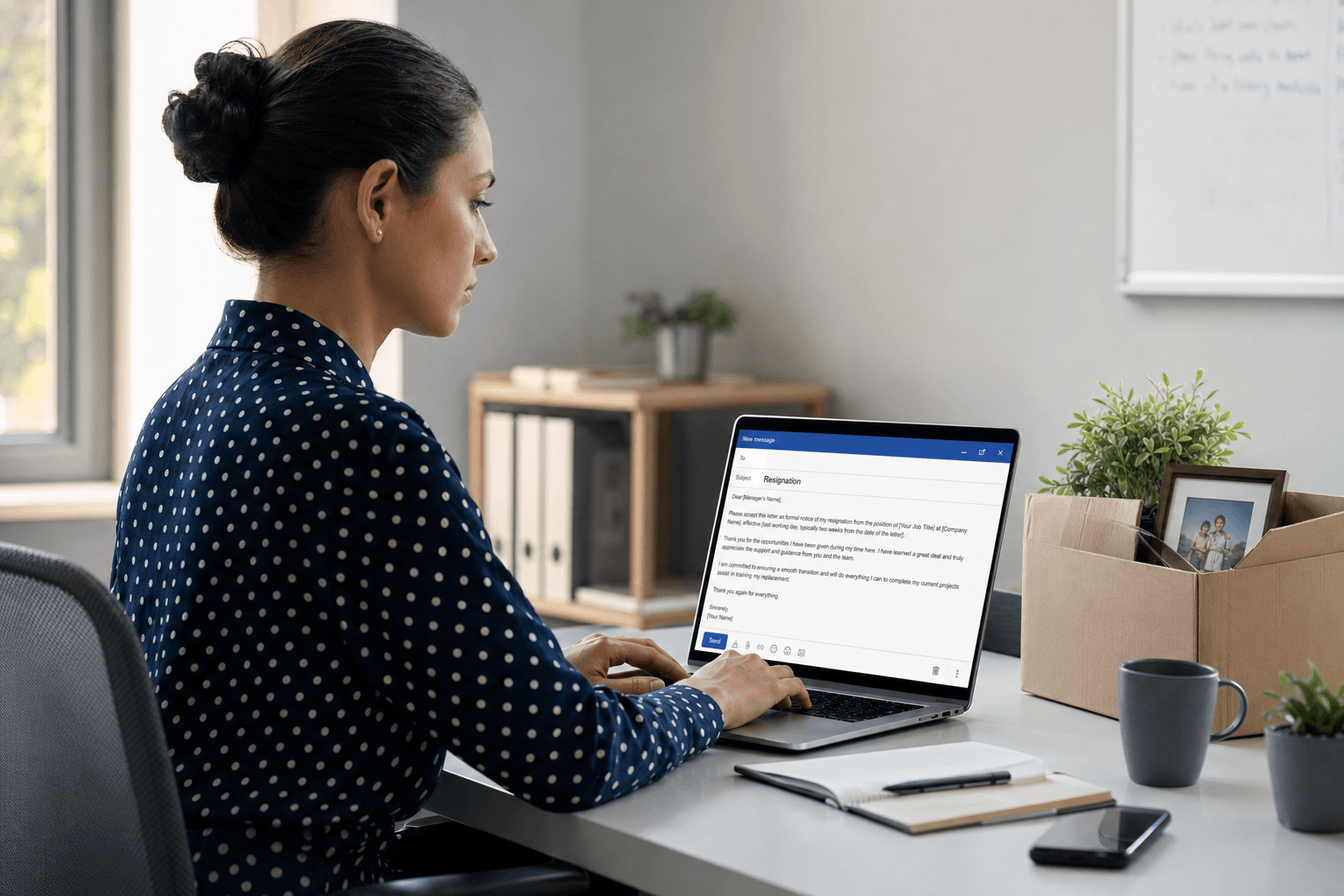
 You've made the decision. Maybe it took months of deliberation, maybe it was sudden, but either way — you're leaving. Now comes the part nobody prepares you for: writing the email.
A resignation email is one of the highest-stakes messages you'll ever send. It's a legal record, a professional bridge, and a personal statement rolled into one. Get it right and you leave gracefully, preserving relationships that may matter for decades. Get it wrong and you burn bridges, create awkwardness, or worse — give your employer reasons to make your notice period miserable.
Here's exactly how to write one that's professional, clear, and impossible to misread.
Before you write: the conversation comes first
Never let your manager find out through email. This is the single most important rule of resigning. Your resignation email should confirm a conversation that already happened — in person, over video call, or by phone. Walking into your boss's office (or scheduling a private call) and saying "I've decided to move on" is uncomfortable, but it's the professional standard.
Why? Because email is impersonal. Your manager deserves to hear it directly, ask questions, and process the news before it becomes an HR document. Blindsiding them with an email — especially if they find out you've already told colleagues — damages the relationship and your reputation.
The email follows the conversation. Think of it as the written confirmation, not the announcement.
What every resignation email must include
Regardless of your reasons, your relationship with your boss, or how you feel about the company, every resignation email needs these five elements:
1. A clear statement that you're resigning. No ambiguity. No "I'm considering..." or "I wanted to discuss the possibility of..." State it plainly: "I am writing to formally resign from my position as [title]."
2. Your last working day. Check your contract for notice period requirements. If your contract says 30 days, your last day should be at least 30 days from the email date. Be specific: "My last working day will be [date]."
3. A brief expression of gratitude. Even if your experience wasn't perfect, find something genuine to thank them for. Growth opportunities, specific projects, mentorship, the team. This isn't performative — it's strategic. You will encounter these people again. Industries are smaller than you think.
4. An offer to help with the transition. "I'm happy to help train my replacement, document processes, or assist with handover during my notice period." This demonstrates professionalism and makes the separation smoother for everyone.
5. A professional closing. Keep it warm but not emotional. "I'm grateful for the opportunity and wish the team continued success."
The template that works for 90% of situations
Subject: Resignation — [Your Name]
Hi [Manager's Name],
As we discussed, I am writing to formally resign from my position as [Job Title] at [Company Name]. My last working day will be [Date], in accordance with my [X-week/month] notice period.
I want to thank you for the opportunities I've had here, particularly [specific project, skill, or experience]. I've genuinely valued [something authentic — the team, the mentorship, the challenges].
During my remaining time, I'm committed to ensuring a smooth transition. I'm happy to help document my responsibilities, train a replacement, or assist with handover in whatever way is most helpful.
Thank you again for everything. I wish you and the team all the best going forward.
Best regards,
[Your Name]
That's it. Short, professional, complete. Notice what's missing: no reasons for leaving, no complaints, no excessive emotion, no essay about your journey. Those conversations happen verbally, not in writing.
What NOT to include
Don't explain why you're leaving. Your resignation email is not the place to discuss your new opportunity, your dissatisfaction, or your reasons. A simple "I've decided to pursue a new opportunity" is sufficient if pressed, but even that isn't necessary in the email itself. The more you explain, the more ammunition you provide for counter-offers, guilt trips, or office gossip.
Don't be negative. Even if the job was terrible, the management was toxic, or the culture was broken — this email lives forever in HR records and your manager's inbox. It can be forwarded, screenshot, or referenced years later. Nothing good comes from putting criticism in writing during your exit.
Don't apologize for leaving. "I'm so sorry to do this" undermines your decision and makes you seem uncertain. You've made a professional choice. Own it respectfully.
Don't CC everyone. Your resignation email goes to your direct manager and, if required by policy, to HR. That's it. Don't CC the entire team, your skip-level, or anyone else. Let your manager decide how and when to share the news.
Don't negotiate in the email. If you're open to a counter-offer (think carefully about whether you should be), that's a verbal conversation, not something to put in writing.
Variations for specific situations
Short notice or immediate resignation:
If circumstances require you to leave sooner than your notice period, acknowledge it directly: "I understand my contract requires [X] weeks' notice, and I apologize for the shorter timeline. I'm prepared to do everything possible to ensure a smooth transition in the time available."
Resigning from a toxic environment:
Keep it even shorter and more formal. Stick to the facts — resignation statement, last day, transition offer. No need for elaborate gratitude if it isn't genuine, but don't be hostile either. Neutral and professional is always safe.
Resigning from a job you love:
Here you can be slightly warmer: "This was a genuinely difficult decision. The team, the work, and the culture here have meant a lot to me, and I leave with nothing but respect and appreciation."
Resigning remotely:
The same principles apply, but since there's no physical office interaction, the email carries more weight. Consider scheduling a video call first, then following up with the email. This is especially important if you've never met your manager in person.
After you send it
Save a copy. Download or forward the email to your personal address. This is a legal document confirming your notice period start date.
Prepare for the counter-offer. If you're a valued employee, expect one. Decide in advance whether you'd stay for more money, a promotion, or different responsibilities. Research consistently shows that 80% of people who accept counter-offers leave within 6 months anyway — the underlying reasons for leaving rarely change.
Maintain professionalism through your notice period. Don't mentally check out. Don't badmouth the company to colleagues. Don't slack on deliverables. Your notice period is the last impression you leave — make it consistent with the professional image you've built.
Manage your email transition. During your notice period, you'll likely need to hand off ongoing email threads, share contact relationships, and redirect communications. This is where having an organized inbox makes the difference between a smooth exit and a chaotic one. If your emails are scattered across a cluttered inbox with no organization, the handover becomes a nightmare — for you and your replacement. Tools like Faraday that automatically categorize and organize your email make this transition significantly easier — everything is already sorted, searchable, and structured.
The best resignation email is one that, five years from now, you'd be comfortable with your future employer reading. Keep it professional, keep it brief, and keep the door open. Your career is long, and the professional world is surprisingly small.
