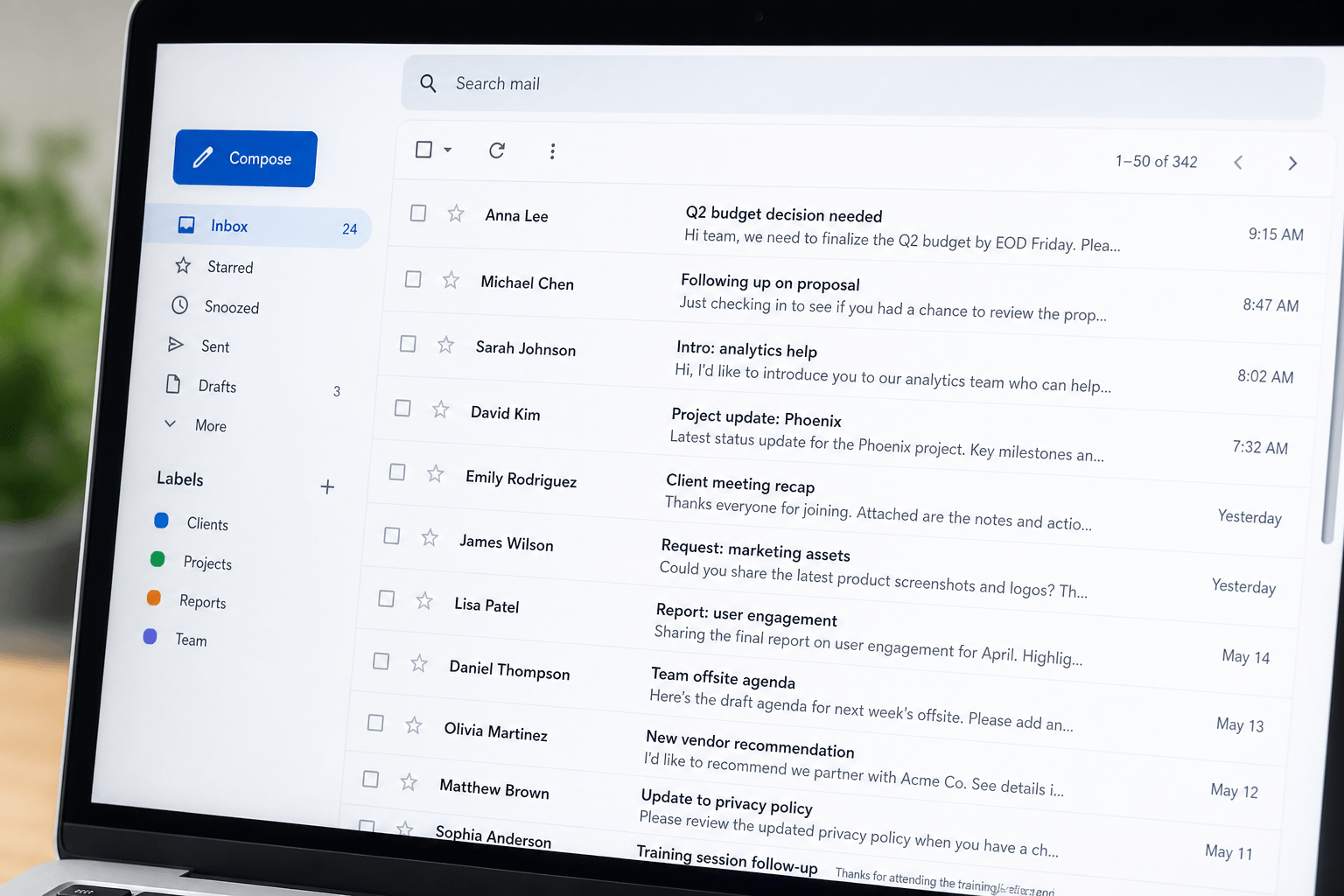
 Most recipients decide whether to open your email from the subject line alone. On mobile, it's often the only thing visible. Get it wrong — vague, misleading, or aggressively formal — and your message dies unread.
Great subject lines share one trait: they make a precise promise about what's inside. Here's how to write them.
The three-part formula
1. Specific outcome or topic. Not "Update" — "Q2 budget: decision needed by Friday".
2. Scope marker when helpful. If it's short, say so: "Two questions on the contract (2 min)".
3. Action clarity for requests. If you need something, say it in the subject: "Please approve: vendor renewal — Acme".
Subject lines that work by scenario
Cold outreach: Lead with relevance, not flattery — "Intro: analytics help for [Company] — referred by [Name]" or "Question on your rollout of [specific thing]".
Follow-ups: Thread the original topic — "Following up: proposal sent April 12". Avoid dishonest "Re:" hacks on new threads; people notice.
Internal asks: "Decision needed: marketing landing page copy" or "Need Legal review — employee handbook diff".
Urgent (real urgency only): "URGENT: payment failure blocking payroll — today". Never cry wolf — when everything is urgent, nothing is.
What fails
"Quick question" — usually isn't quick and tells them nothing.
"Touching base" — meaningless filler.
ALL CAPS — reads like spam unless extremely rare and justified.
Misleading clickbait — destroys trust once opened.
Subject lines and search
You'll thank yourself later if subjects contain keywords you'd naturally search — project codenames, client names, invoice numbers. When every random thread says "Hi," search becomes torture.
That habit pairs perfectly with clients that support fast search and operators — including Faraday, where strong subjects plus powerful queries mean you're never archaeology-ing through memory to find the thread again.
Treat your subject line as the headline of the email — because to everyone scanning their inbox, it is.